
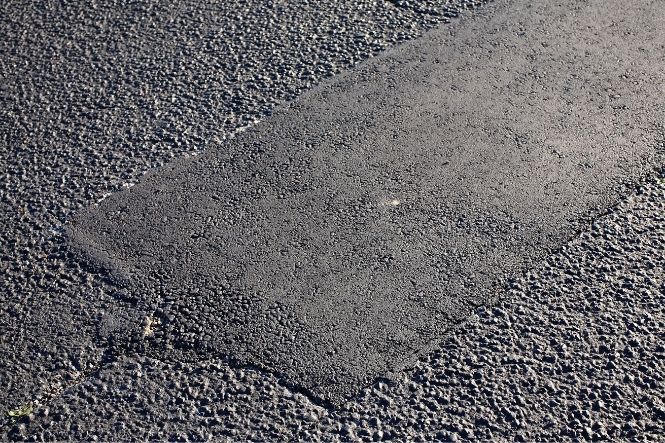
Do you have a hole in your driveway, or maybe a larger area? You might be wondering how to fix it. In this blog post we will show you how to patch up any holes and cracks in your tarmac with hot asphalt material. If you need help getting the right materials for the job, then read on.
It is a sad fact that a patch in tarmac, like many other drive surfaces that are laid wet, will almost certainly show whatever you do. But there are a number of methods available, and it’s certainly cheaper than Relaying The Whole Surface.
Table of Contents
Pre-Mixed Tarmac For Smaller Holes
For patching small holes, the DIY householder is probably better off using pre-mixed bags of tarmac available from builders’ merchants. Although this is more expensive per square metre and you won’t get as good a finish as with proper tarmac, you won’t have all the mess and fuss associated with manipulating hot tarmac.
The pre-mixed tarmac is blended with a retardant that prevents the tarmac from setting, and exposure to the air kicks off the setting process. It’s best to allow the bags to warm up before they are opened, as it helps the tarmac flow. There is no need for blowtorches or anything like that, just leave the bags in a warm room for a few hours or overnight.
Clean out the holes to be patched, removing any loose material and moisture. Then pour the tarmac mix in, tamping down and levelling in the same way as ordinary tarmac. Because of the retardant, which takes a while to evaporate, the patch will take a number of weeks to harden properly, and even then may not be as hard as the surrounding surface, so take care with sharp pointed objects.
Larger Jobs
The second method of repair is, of course, to get proper tarmac in. This will almost certainly be cheaper and more worthwhile for a series of patches or a larger area.
With big holes you should cut out a rectangular area surrounding the patch using a power saw. Then chip out the remaining old tarmac with a cold chisel or bolster, or with a jack-hammer for a larger area. The sides of the hole should then be treated with cold pour, a jointing compound, to keep water out of the exposed areas.
Hot tarmac can then be spread into the hole and levelled with a heavy roller, which can be hired for the day if necessary. The whole surface can then be rolled to level out any differences. You’re not done with the asphalt until it has fully set and is hard, though, so don’t drive on the patch for a couple of weeks.
There is no reason why you shouldn’t just fill in the hole completely if it is big enough.
Getting Hold of Hot Tarmac
The biggest problem is likely to be getting the tarmac. Delivery of a small amount of tarmac can be prohibitively expensive, as suppliers prefer to carry full loads. You could spread the cost by coordinating with neighbours who need to patch their drives, but all of them must be ready to take the tarmac when it arrives, so they will need to commit to doing the initial preparation on the day.
If you are lucky, you might find a local supplier who will load an amount into a trailer or pick-up for you to take home and apply. If you do this, apart from the fairly obvious point that you should line the load bed to avoid the tarmac messing it up forever, you will need to cover it with tarpaulin and old blankets or sacking to keep it hot during the homeward journey.
Warning: Don’t apply fresh hot asphalt material on broken, cracked or damaged ground, there is a risk of subsidence, and the asphalt will not adhere well.
If your tarmac has already set in the wrong place and you need to remove it, then get hold of an oil-based paint stripper (never use water on hot tarmac) and use this to remove the upper surface. Once the paint is scraped off, you should be able to chip out any large lumps of tarmac using a cold chisel or bolster. You can then scoop away what remains with a spade, bucket or wheelbarrow; if you are lucky it might all come away at once.
If you use the hot asphalt remover, make sure it is completely non-toxic, otherwise make sure any spills will not harm plants or animals or seep into drains. If possible, avoid getting it on your skin. If you do get it on your skin remove it as soon as possible using lots of soap and water, or if necessary a solvent. The product should be best applied to wet tarmac because it won’t evaporate as quickly.
Keep Off!
With both methods, it’s best to keep cars and feet off the area for a while. This will prevent tarmac and aggregate from sticking to them, and being spread around the rest of the drive and into the house.
In fact, the whole area should be kept clear until the tarmac has been fully set and is hard – which can take a couple of weeks depending on weather conditions. This will stop you walking or driving straight into it as soon as it is laid, which could then rip it up if you try to drive over it too quickly.
For more information on tarmac, read our articles The Art of Laying Tarmac and Tarmac Options For Your Driveway And Patio.)
Conclusion
While there are many ways that people use for repairing tapons, the most common method is by cutting out an area around it using a power saw or jack-hammer. Afterwards, you should apply a cold pour jointing compound on both sides so water cannot enter into any exposed areas.
Now hot tarmac can be applied with heavy rolling equipment such as rollers in order to level out the surface making sure joints are not too deep which would cause cracks when walking on them without shoes; this process will take 2 weeks before driving over the patch again because once set and hard they could rip up if driven upon quickly due to easily being gripped while wet but dry enough after about two more
