
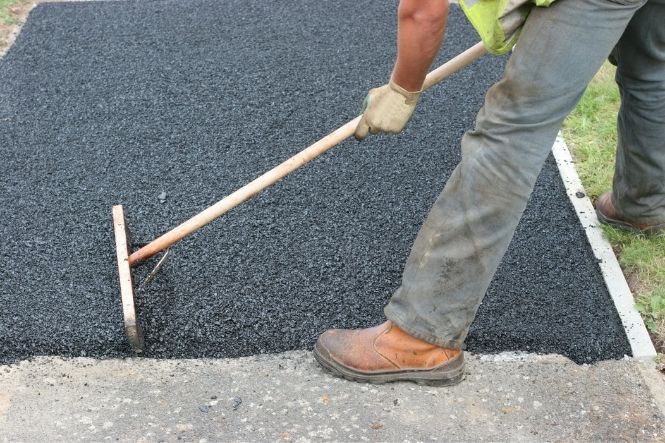
If you’re looking for a new driveway or patio, there are many options available that will suit your needs. This article is going to explore the different tarmac style materials and their benefits and disadvantages in order to help you make your decision.
In its simplest form tarmac, also called asphalt, can be used to resurface your driveway or patio. This is the most forgiving of surfaces and still allows for drainage as well as water runoff thanks to the course gravel within it. This type of tarmac surface will often last between 20-30 years
Table of Contents
Why a Tarmac Driveway?
Tarmac is generally considered to be the cheapest method of laying a hard surface. But it’s a time-consuming job which requires specialist tools, machinery and, not least, knowledge. This means that it only becomes the cheapest method once the driveway is up to a suitable size, where the economies of scale kick in.
For these reasons, tarmac is not something that can reasonably be considered as a DIY job, unless you have friends or relatives in the trade who are going to help you out, particularly with the machinery. If you’re going to Talk To Contractors, you’ll need to know that tarmac is more properly called bitmac.
Bitmac or Tarmac?
The name tarmac was original derived from John MacAdam, who developed the process in the West. He used tar, which can be found naturally, to hold the small stones together, hence the name tar macadam, or tarmac for short.
The difference between bitmac and tarmac is the binding agent for the aggregates is bitumen, a by-product of the oil refining process, rather than tar, it is known as bitumen macadam, shortened in the trade to bitmac.
Consider Where you use Tarmac
You do need to think hard before deciding on tarmac for a driveway outside your home, particularly if you like to work on cars or motorcycles as a hobby. Petrol or diesel spills, or splashes of other solvents like penetrating oil, will break down the hardened top surface then eat their way through the lower layers. This process can’t be reversed and soon the aggregates begin to spill out of the resulting hole every time a car tyre passes over it. The hole will grow, look very unsightly, and it can only be fixed by Patching, which doesn’t look great.
You need to consider the effect on your neighbourhood area, too. If all the other drives in the street are tarmac, perhaps because they were all done in one go when the houses were built, then obviously it will fit in beautifully. But if that’s not the case, and all the other drives in the street fit in with the period of the property, then yours will stick out like a sore thumb, and possibly make the house a little harder to sell. Your neighbours won’t thank you for putting down an eyesore either.
It’s not really a good surface for a recreational patio or another garden area, as it’s not that attractive and can get hot in summer, which is when you want to use that space. Having said that, you might want to have an area in the garden for kids to play ball sports or games on, if you have space. If you’re going to get a drive laid anyway, the extra cost of doing part of the garden won’t be a great deal more, since the people, machinery and supplies will be coming to you anyway. Just don’t forget to leave enough room for the cars to get off the drive onto the road.
A tarmac driveway or patio will be less susceptible to frost heave than a brick, block-paved, stone or concrete one as it’s porous. You can keep out weeds growing in from adjoining areas with weed membrane and there is plenty of room for sprinklers and water run-off pipes as this can be a problem with other types of drive.
Tinker with the Size and Colour of your Driveway Materials
If you do decide to go for tarmac (or bitmac), it’s worth knowing that there are many different types and even colours. This might make it a bit more palatable for a residential property or in a garden. The main differences are in the size and type of aggregate used, and the type of binding agent.
Different size of aggregate to that normally used for roads can do a lot to set your driveway apart from just another piece of road, and coloured aggregates are available that can help a driveway blend into its surroundings. Although the choice of binding agent is best left to the professionals, to be taken on functional grounds, there are coloured binders available. If they can be used in your situation and match, or get close, to the colour of the aggregate, then the effect can be very pleasing.
A specialist installer will be able to give you the full rundown on all the technicalities and offer options for your particular needs, after an assessment of what will work best at your property.
You may not need building regulation approval for a tarmac driveway or patio, but check with your local planning department. It is the council’s job to make sure that planning permission isn’t required for driveways and patios.
It might seem like quite a lot of effort to go to, but you’ll be very glad you did if the council or neighbours object to what you have done.
Conclusion
In conclusion, bitmac is a great surface for roads, but it’s not as good in a garden or on a driveway around your home. You might want to consider other options before making the final decision.
If you decide to go ahead, and the work is being carried out for you rather than doing it yourself, then make sure that the company installing it does so to a high standard.
A good quality bitmac driveway or patio should add value to your property and give you a pleasing surface to drive upon.

