
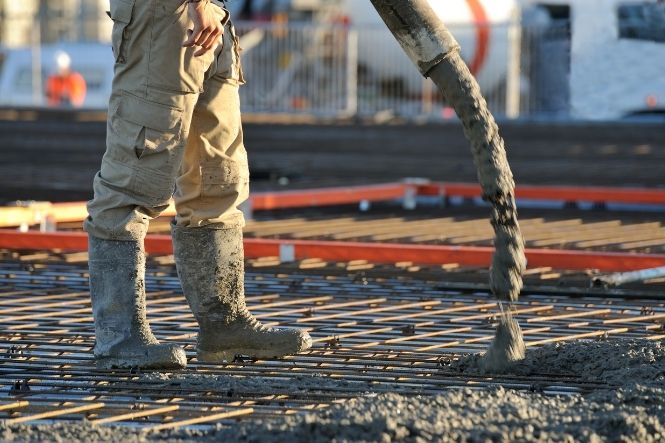
Laying a concrete driveway is a job that householders often take on as a DIY task, and there’s no reason why you shouldn’t achieve a good, long-lasting job, as long as you take care in the preparation and the laying. Unless you have a very long drive, it’s likely that you’ll have to mix the concrete yourself from raw materials, so the first job is to buy, hire or borrow a cement mixer.
Prepare the Tools and Site
Once you know when your mixer’s going to be available you can prepare the ground. Do this by removing whatever is on the top layer of the site. Whether it’s an old drive, grass or just dirt, you’ll need to go down about 10cm. If the ground is very poor, you might need to go down another 10cm then fill that up with crushed and levelled hardcore (see our article Excavating For A Driveway on this site).
Make sure there are no weeds left and treat the site with a general purpose weedkiller if there are any doubts. Then set up boundaries to keep the concrete in the right place when it’s poured on. This can be existing walls, decorative stone blocks or bricks, or temporary wooden barriers that will be removed once the concrete has set properly (see our article Formwork For Concrete Drives on this site). Any temporary barriers, known as shuttering or formwork, will need to be treated with release agent so that they can be removed afterward without damaging the concrete.
Get the Concrete Down
Lay down a damp-proof membrane which will stop the wet concrete from drying out too quickly, and also protect it from any chemicals (such as chlorides) in the base or sub-base, which might attack the underside of the concrete. Once that’s down it’s time to mix up the concrete according to the manufacturer’s instructions. It can be levelled off initially with a spade or strong rake before being tamped down.
Tamping involves taking a timber with a straight edge and using it to tap down on the surface of the drive across its width, working from one end to the other. This spreads the concrete evenly along the drive and levels it, but also brings trapped air to the surface and makes sure the concrete is firmly bedded down onto the aggregate in the sub-base.
Finishing with Care
Concrete is often finished with mechanical smoothing machines once it’s begun to cure, but for a domestic drive you’re unlikely to want to go to the trouble. Apart from anything else, a smooth surface can be treacherous in the winter, so it’s probably best left well tamped and then finished with a course brush, stoking parallel to the driveway. The resulting grooves will help drainage and give grip when it’s wet.
With a house driveway it’s not really necessary to worry too much about the drying out and curing processes. If it’s likely to be a cold night, then sacking, straw or old carpet can be used to cover the drive overnight. It ought to be checked after 10-12 hours so that any minor flaws can be touched up or smoothed over before it hardens completely.
When to Use Your Driveway
After 24 hours you can take the shuttering away from the edges. It can be left for up to three days if necessary, but any earlier and the edge won’t form properly. Take care when you are removing it to avoid damaging the edge. Keep everyone and anything off the drive for the first couple of days, and cars should not be used on the drive for at least five days. After that, it’s yours to use and admire.

