
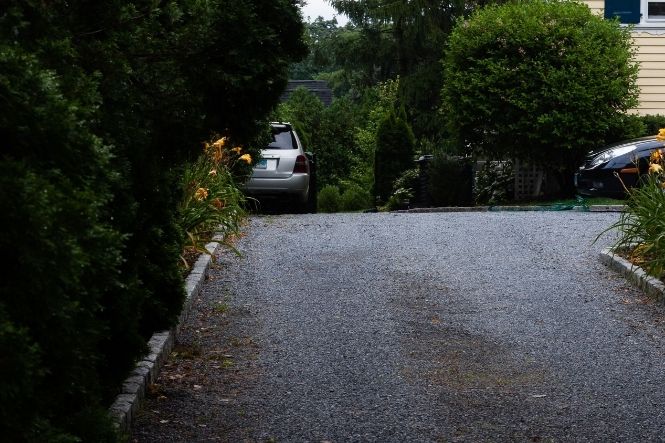
This article covers the loose materials available for constructing driveways that are similar to gravel but not classed as such. Gravel is made from stone that’s been broken down and smoothed, to a greater or lesser extent, either naturally in rivers and on sea beds, or artificially, as a by-product of quarrying activities.
Gravels are covered in detail in our article in this section (read Gravel Driveways: The Advantages and Disadvantages and Looking After Gravel Drives), but these other materials that are often used for driveways have a similar consistency and density to gravel. They are graded hoggin, crag, cinders and ash and none of them are made from stone.
Graded Hoggin
Graded hoggin is a mix of sands, clay and gravel that was historically popular in the south and east of England. Because of the mix of materials, graded hoggin, when compacted, forms a semi-solid driveway surface similar to that of self-binding gravels, which are more prevalent in the north.
It’s on a longer, well-used drive that graded hoggin is likely to be most useful. This is because it beds down and sticks together, forming a fairly comfortable and level road surface that can withstand medium to heavy use. It won’t be anywhere near as durable as Tarmac or Concrete, but it will cost considerably less, and it can be topped up over the years quite a few times before eventually requiring complete re-laying.
Coal Ash and Cinders
Cinders or ash refer to the coal ash by-products from coal-fired power stations and, as they are generally being decommissioned these days, they are getting harder to find. If you do come across coal ash or cinders at a decent price, then it makes just as good a surface as gravel, except that it only comes in black or charcoal colour, unsurprisingly.
This option be a very effective contrast in the right location, but it depends on the overall landscaping that you’re doing. Beware of grades that won’t be effective as a driveway gravel, though. PFA (Pulverised Fly Ash) is one example that is simply too small and light to be of much use on a drive.
Crag – one for the Equestrians
Another gravel-like product, but this time one that’s more specialist, is crag, which is made from crushed shells. Previously popular in East Anglia and the south-east of England because of the availability of the right kind of shell, it is now a favourite for equine establishments.
It is less likely to be dragged about by pedestrians and horses, and is said to be used in Royal Parks for this reason. It isn’t widely available but could be the right material if you have a driveway that is likely to be used as much by horses and people as cars and other vehicles.
Chose the Right Product and Lay it Down
Laying products like coal ash, cinders or graded hoggin is no different to laying gravel (which is covered in our article in this section) and should be reasonably straightforward and painless. The only real problem is choosing between all the different products available, something that will probably come down to look, local availability and cost.

